
Reduce manual re-entry, operational chasing and delays between your existing systems.
Systemix helps Singapore service and maintenance SMEs understand recurring operational bottlenecks, improve the underlying process and connect existing software where integration is justified.
Understand the process. Connect the systems. Make the work flow better. We start with evidence and recommend standard software—or no build—when that is the better answer.
Individual tools work. The process between them often does not.
The solution is usually not another dashboard. It is understanding the real process, removing unnecessary handoffs and controlling the cases that cross people, rules and existing systems.
The process crosses tools that do not work as one
Work moves through field apps, email, messaging, spreadsheets, accounting systems and shared files, while people manually carry status and data between them.
Staff repeatedly chase, check and re-enter information
Missing context, duplicate records and unclear states force teams to reconstruct what happened before the next person can act.
The normal path works, but exceptions disappear between teams
Without an explicit reason, responsible role, next action and due time, unusual cases wait while everyone assumes somebody else is handling them.
Improve one process at a time.
Systemix does not force every business into the same use case. The initial conversation explores where work actually breaks; any paid diagnostic and pilot remain tightly bounded to one agreed process.
Process Discovery & Integration
Systemix works with businesses to understand recurring processes first. We help to discover whether there is a problem worth looking into.
- Trace recent normal and exception cases across people and tools
- Build a process-opportunity register without promising every workflow
- Select one bounded, material process for paid diagnosis
- Recommend redesign, configuration, software, integration—or no build
Operational Handoff Diagnostic
Before development, we provide an in-depth process diagnostic to map what really happens and discover where delays, errors, mistakes and inefficiencies occur before making a recommendation.
- Defined boundary and evidence-backed current-state map
- Exception, ownership, system and data analysis
- Baseline and acceptance-measure definitions
- Options, recommendation and a separately scoped pilot brief
Integration, standard software and ERP replacement solve different problems.
Systemix is appropriate when a valuable handoff crosses tools that should remain in place. If a standard product or broader platform change is the better answer, our recommendation will say so.
| Scope area | Process & systems integration | Standard software implementation | ERP replacement programme |
|---|---|---|---|
| Primary purpose | Improve one valuable handoff across existing tools and teams | Adopt a product workflow for a defined function | Consolidate broader business functions onto selected modules |
| Starting point | Evidence-backed map of the real process, decisions and exceptions | Product fit, configuration and migration requirements | Programme, module and operating-model requirements |
| Authoritative records | Existing systems remain authoritative unless an approved scope changes them | The product becomes authoritative for its configured function | The ERP becomes authoritative for implemented modules |
| Approvals and exceptions | Designed around the mapped workflow and named owners | Determined by product capability and configuration | Determined by modules, configuration and programme governance |
| Scale decision | Pilot one bounded outcome, measure, then scale or stop | Roll out according to the implementation plan | Deliver through a phased transformation programme |
This is a scope comparison, not a performance ranking. Capabilities vary by product, provider, configuration and implementation scope.
A real ordering process redesigned around structured intake and controlled approval.
This client workflow was built after analysing how orders actually moved from customer messages to staff, pricing, approval and receipt preparation.
From manual message re-entry to an approved PDF and structured records.
The implemented workflow connects AppSheet, n8n, an approval channel, document generation and structured spreadsheet records. It preserves individual product and order-line identities so multi-product orders can be processed against the intended records.
Process studied
Existing message-to-order receipt workflow
Structured intake
AppSheet with guided product selection
Workflow control
n8n validation, pricing logic and routing
Human approval
Telegram in this implementation; channel can vary
Messages were manually copied into an order receipt.
The client’s customers placed orders through a messaging platform. Staff received the message and manually re-entered the order into a receipt.
- The client reported that receipt preparation normally took about 10–15 minutes per order.
- Repeated copying created more opportunities for transcription, quantity or item-selection mistakes.
- Pricing, review and document preparation depended on several manual handoffs.
- Process was manual which caused delays and inefficiencies.
Structured intake now feeds pricing, approval and PDF generation.
The redesigned automated workflow follows the client’s real ordering process while maintaining business rules.
- A guided AppSheet form captures the customer and order lines in a consistent structure.
- An authorised business user selects the applicable customer-group pricing.
- The priced order summary is routed to the client’s authorised approver.
- After approval, the workflow generates a print-ready PDF and updates the structured order records.
- 01Customer submits a structured order
- 02Order lines and identifiers are validated
- 03Authorised user selects customer-group pricing
- 04Priced summary goes to the authorised approver
- 05Approval or rejection is recorded
- 06Approved PDF and structured records are produced
Order details move forward without repeated copying
The structured intake leads to more consistent order receipt details and a clearer database.
Pricing and approval happen at explicit checkpoints
Customer-group pricing is selected by an authorised user, and the approver’s decision is captured before the PDF is produced.
Approved orders produce a repeatable record set
The workflow produces the intended order receipt PDF and structured order records using the validated order data.
Evidence note: the 10–15 minute figure is the client’s description of the previous process. The new handling time and error rate have not been independently measured, so Systemix does not claim a percentage saving or quantified error reduction.
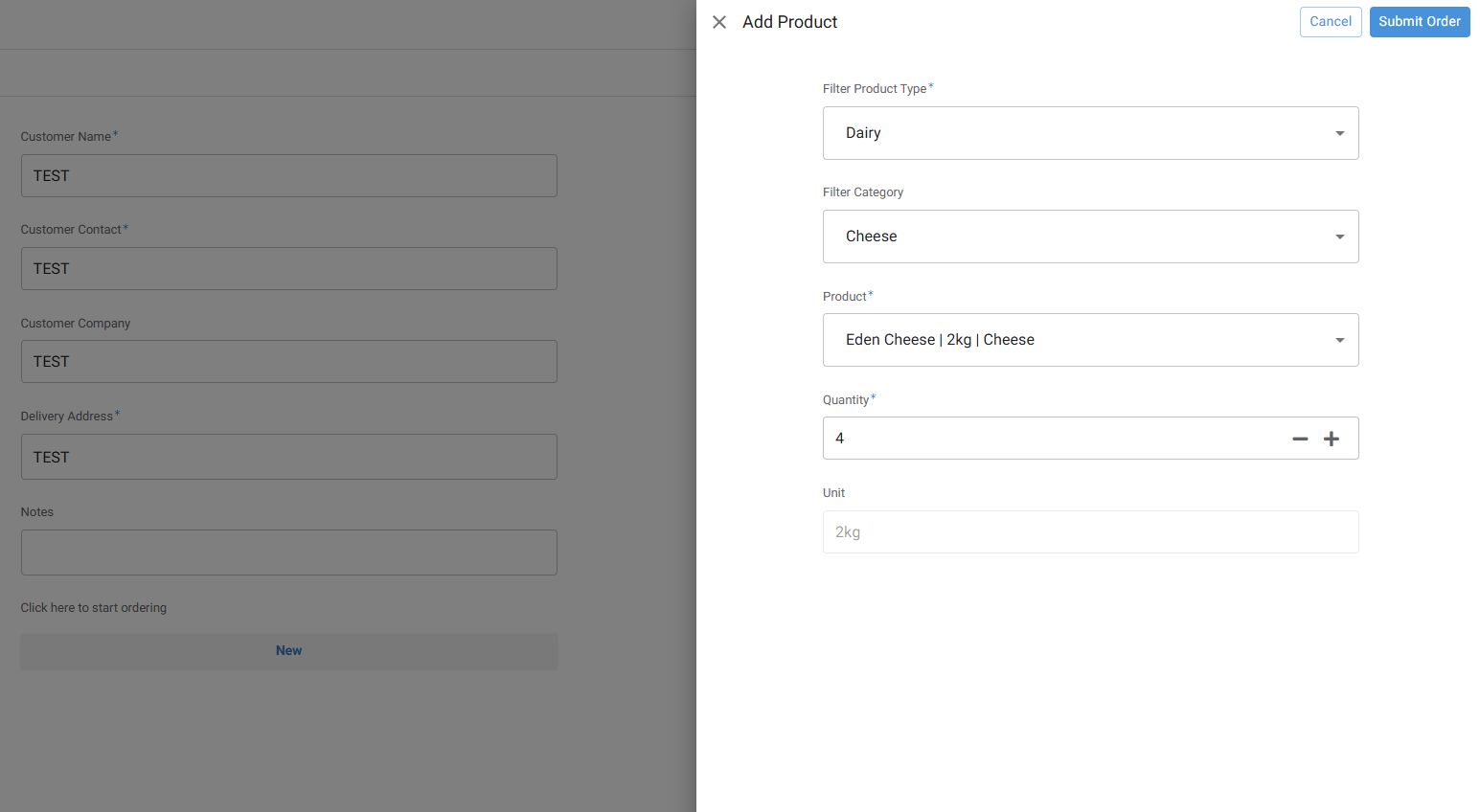
AppSheet Order Intake Interface
Clean and simple ordering intake form with appropriate filters to accommodate the client’s large product list while keeping it user friendly for their customers.
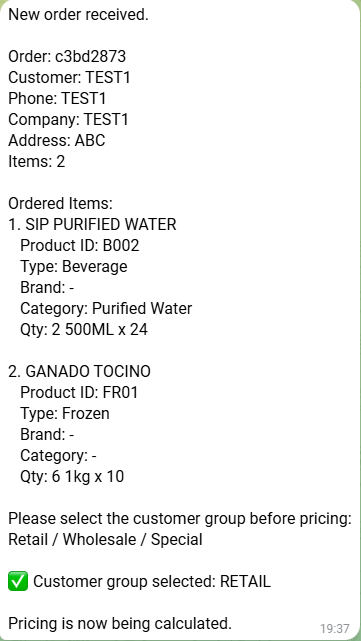
Order Detail Summary Notifications
Order detail summaries are generated and sent to the client’s authorized user for customer group pricing and approval.
Evidence before scale.
Each stage reduces a different uncertainty. Make better-informed decisions at every step.
Free Process Conversation
Explore one recurring process, review one recent normal case and one exception case, confirm the process owner and decide whether there is a bounded problem worth diagnosing.
Paid Diagnostic
A structured, evidence-based investigation of one operational workflow that converts an unclear business problem into a verified process model, prioritised improvement recommendation and implementation decision.
Controlled Pilot
Test the smallest safe change with representative users, systems, exceptions, controls, measures and a fixed scale-or-stop decision.
Production and Care
Harden the accepted workflow, document ownership and recovery, reconcile outcomes and support reliability or improvement under an agreed scope.
A dependable handoff needs more than a successful demo.
Production value comes from clear authority, controlled exceptions, trustworthy records and accepted recovery—not simply from connecting two applications.
Process evidence before tool choice
The actual steps, waits, decisions and exceptions are traced before a build or product is recommended.
Systems of record stay authoritative
The integration coordinates approved data and actions; it does not quietly become an unofficial CRM, ERP or accounting ledger.
Human authority where consequences matter
Approvals, overrides and decisions involving safety, price, tax, credit or legal judgement remain with authorised people.
Exceptions become owned work
A failed or incomplete case records a reason, responsible role, next action, and escalation path instead of disappearing into a queue.
Security, PDPA and recovery are designed
Access, personal-data minimisation, environments, logs, retention, testing, monitoring, reconciliation and fallback are agreed for the scope.
Bring one recurring process that creates chasing, waiting or rework.
You do not need to know the solution or choose a flagship workflow. The first conversation tests whether the process is important, observable and bounded enough to justify deeper evidence work.
Short no-cost process conversation
Explore one recurring process using a recent case, its consequence, owner, systems and available evidence.
Paid single-process diagnostic
Produce decision-grade process, exception, system, risk, baseline and option analysis.
Explicit next decision
Stop, improve the process, configure or buy standard software, or commission a controlled pilot.
Clear answers before we talk.
If your question is not covered here, include it when you request a process conversation.
Process and systems integration is the practice of connecting business workflows and software applications to ensure business activities and software work together in a unified ecosystem.
No. Completion-to-Cash is one useful reference pattern for technical-service businesses, not Systemix’s identity or an assumption imposed on every client. Discovery may instead surface work-intake, dispatch, quotation, materials, supplier, service, finance or compliance handoffs as the better priority.
Usually not. Systemix starts by testing whether the valuable gap sits between tools that should remain. If a standard product or broader platform change is the better answer, the diagnostic should recommend that instead of a custom integration.
The paid diagnostic is a structured, evidence-based investigation of one operational workflow that converts an unclear business problem into a verified process model, prioritised improvement recommendation and implementation decision.
The initial focus is commercial technical-service and maintenance SMEs, including HVAC, fire-protection, electrical, M&E, security-system and commercial-equipment service firms. Other businesses may also be suitable, but suitability still depends on a repeated and material process, accessible evidence, accountable owners and supported system access.
Use a standard product when the process is common, the product fits the important requirements and configuration is more responsible than custom work. Systemix should not rebuild scheduling, accounting, CRM or ERP functions that a suitable supported product already provides.
The first process conversation is short and no-cost. Client-specific mapping and option design belong in a paid single-process diagnostic. Pilot, production, software and support costs are scoped separately after the relevant evidence, access and acceptance requirements are understood.
Data handling is scoped for each engagement. The intended approach is to minimise unnecessary personal data, use appropriate access controls, separate test and production, agree logging and retention, review third-party services and preserve human authority for consequential decisions. Final obligations are set by the applicable agreement and law.
Discuss one recurring process that does not flow cleanly.
Describe what starts the process, the intended outcome, the people and systems involved, and where work begins to wait, repeat or lose ownership. Do not submit confidential records through this website enquiry form.
- One process family—not the entire business
- One normal case and one exception case
- A clear learning, no-fit, standard-software or diagnostic decision
By submitting this website enquiry form, you acknowledge that Systemix will use the information you provide to respond to your enquiry, as explained in our Privacy Notice.
Prefer email? Contact m.sanchez@systemix.sg
Process and systems integration for Singapore B2B operations. We map real workflows, connect existing tools and control valuable handoffs around a measurable outcome.
© 2026 Systemix. All rights reserved.
Singapore-focused process and systems integration.